

Air compressors are used across manufacturing, new energy, pharmaceuticals, construction, and many other industries. They run pneumatic tools on production lines, move gas in new energy plants, and even inflate tires. Most people use them every day without thinking about what happens inside.
This article explains how an air compressor turns ordinary air into high-pressure gas — in plain language, step by step.
What an air compressor actually does
The job of an air compressor is simple to state: it takes in ordinary air, compresses it, and stores it as high-pressure gas that can do work.
A useful way to picture it is a bicycle pump. When you push the handle down, the space inside the pump shrinks, the air is squeezed, the pressure rises, and the air flows into the tire. An air compressor is essentially a much larger, automatic version of that pump — far more efficient, capable of much higher pressure, and able to deliver a steady supply of high-pressure gas without stopping.
Normal atmospheric pressure is about 0.1 MPa. An air compressor can raise that to 0.7–1.6 MPa or higher. The high-pressure gas is then distributed through pipes to equipment, driving machinery and completing production tasks.
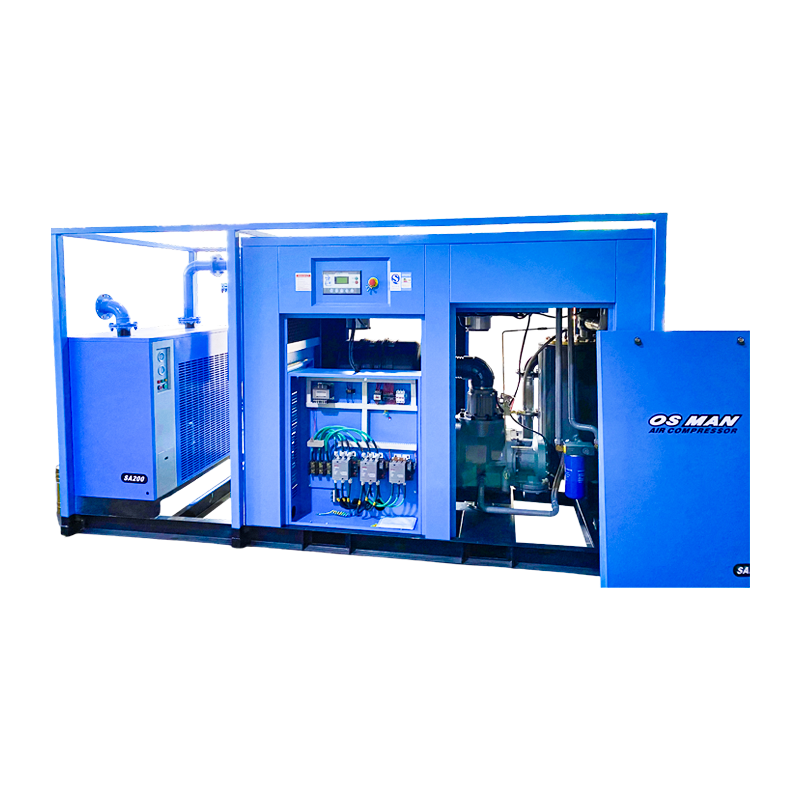
How the compression cycle works: four stages
Stage 1 — Intake: drawing in fresh air
When the compressor starts, the internal cylinder (or the screw rotors or impeller, depending on the type) expands. The internal volume increases, pressure drops, and a negative pressure zone forms.
The intake valve then opens automatically. Ambient air — filtered to remove dust and impurities — is drawn into the compressor. This completes the intake stage.
Why filtration matters: impurities entering the unit would wear out components and reduce air purity. This is especially critical for oil-free compressors used in pharmaceutical and electronics plants, where the filtration requirements are much stricter.
Stage 2 — Compression: squeezing the air to raise pressure
This is the core step. After intake, the cylinder (or screw rotors) contracts. The internal space shrinks sharply, and the trapped air is forcibly compressed.
The physics is straightforward: the smaller the volume, the higher the pressure. During compression, pressure rises rapidly and temperature follows — the same reason a hand pump gets warm when you pump it quickly.
Different compressor types compress in slightly different ways. Screw compressors use two intermeshing rotors; piston compressors use a reciprocating piston. But the principle is identical: reduce the volume, raise the pressure.
Stage 3 — Discharge: releasing the high-pressure gas
When the air reaches the preset pressure (0.8 MPa is common in factories), the exhaust valve opens automatically and the compressed gas moves into the air receiver tank.
The receiver tank does three jobs:
1. It stores high-pressure gas, so the compressor does not have to start and stop constantly.
2. It lets the gas cool down — compressed air is very hot, and the tank allows part of the heat to dissipate naturally.
3. It settles out moisture. Water condenses when air is compressed, and the tank collects it, protecting downstream equipment from water damage.
Stage 4 — Cooling: bringing temperature back down, then repeating the cycle
Compression generates a lot of heat — discharge temperatures can exceed 100°C. Without proper cooling, the compressor's service life drops, and the quality of the high-pressure gas suffers (hot gas expands, causing unstable pressure).
So the discharged gas, and the internal components, are cooled by an air-cooled or water-cooled system back toward room temperature. Part of the gas goes directly to equipment; the rest returns to the compressor inlet for the next cycle of intake → compression → discharge → cooling.
This cycle runs continuously, which is how an air compressor delivers a steady supply of high-pressure gas, day in and day out.