

Choosing the right working pressure for a screw air compressor isn’t about going bigger—it’s about going smarter.
Higher pressure means higher energy consumption. If your tools only need 7–8 bar, a 13 bar machine will waste power and raise operating costs with no real gain.
Too low, however, and you risk pressure drops, unstable equipment performance, and production delays.
So, 8 bar, 10 bar, or 13 bar?
It comes down to three factors:
- Your equipment’s actual pressure requirements
- The layout and length of your piping system
- Expected pressure loss across your distribution network
Match the compressor to your real needs—not to a bigger number.
1.Air Compressor Pressure – What It Means
Air compressor pressure is the delivery force of compressed air into your system. Measured in bar, MPa, or psi.
Quick conversions:
- 8 bar ≈ 0.8 MPa ≈ 116 psi
- 10 bar ≈ 1.0 MPa ≈ 145 psi
- 13 bar ≈ 1.3 MPa ≈ 189 psi
Choose pressure based on what your equipment needs.
Don't confuse rated pressure (at the compressor) with working pressure (at the tool). A tool requiring 7 bar may need slightly more at the outlet to offset losses through pipes, filters, and fittings.
But avoid over-pressuring—it only adds cost, not performance.
2.8 Bar Air Compressor
A common industrial choice. Most pneumatic tools run well at 7–8 bar.
Uses: manufacturing, furniture, CNC, packaging, textiles, auto shops, hand tools.
Pros: balanced output, lower energy, reasonable cost, reliable.
Pick 8 bar if your equipment needs 6–7 bar and your piping has minimal loss. No need to overpay for unused pressure.
3. 10 Bar Screw Air Compressor
A 10 bar screw compressor delivers extra pressure margin for heavy-duty setups and long-distance air lines.
Ideal For:
- 8–9 Bar Equipment: Ensures stable pressure at the tool.
- High-Pressure Processes: Meets demanding process specs.
- Piping Pressure Drops: Offsets losses in long or complex pipe runs.
- Mixed-Pressure Duty: Powers diverse pneumatic tools on one network.
Energy Alert: Skip 10 bar if your facility runs on 6–7 bar. Every extra 1 bar adds ~7% energy cost.
Bottom Line: Ideal for medium-to-heavy industry where standard 8 bar units lack overhead.
4. 13 Bar Screw Air Compressor
A 13 bar screw compressor is built strictly for high-pressure industrial applications requiring extreme air output.
Typical Applications:
- High-Pressure Processing: PET bottle blowing, specialized molding, and high-pressure testing.
- Heavy Machinery & Storage: Heavy-duty pneumatic equipment and high-pressure storage systems.
- Long-Distance Distribution: High-friction runs needing severe pressure offset.
Energy Alert: Never buy 13 bar for "extra safety margin." Unneeded pressure dramatically inflates power bills with zero performance gain.
Pro Tip: High-pressure systems require total integration—ensure your receiver tanks, dryers, filters, and piping are all rated for 13+ bar.
5. 8 Bar vs. 10 Bar vs. 13 Bar: Quick Comparison
Choosing the right pressure comes down to matching your facility's real-world demand:
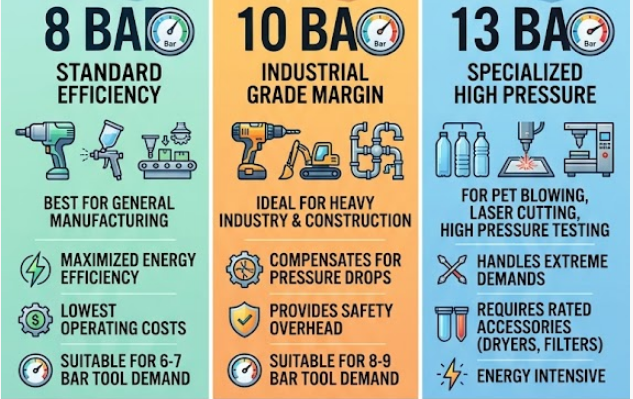
- 8 Bar (Standard): The go-to choice for general manufacturing. Offers maximum energy efficiency and lowest operating costs for standard 6–7 bar tools.
- 10 Bar (Industrial): Built for heavy industry. Provides extra pressure margin to offset friction losses in long or complex piping networks.
- 13 Bar (Specialized): Reserved for extreme-pressure applications like PET bottle blowing, high-pressure testing, and specialized processing.
- The 7% Rule: Every 1 bar increase in pressure consumes roughly 7–8% more electricity.
- Runtime Multiplier: For 8, 16, or 24-hour operations, unnecessary pressure creates massive compounding electrical costs.

- Audit Equipment Requirements: Map out the exact minimum pressure needed by your highest-demand machinery.
- Account for Line Drop: Add buffer for friction losses across long pipe runs, undersized lines, dryers, filters, and valves.
- Verify Peak Load Stability: Ensure pressure holds steady when all machines cycle on at once.
- Eliminate Over-Specification: Avoid arbitrary safety margins that inflate daily electricity bills.
- Plan for Expansion: Factor in pressure specs for planned equipment additions over the next 2–3 years.
Pro Principle: The goal is maximum pressure stability at the machine, not maximum pressure at the compressor discharge.
8. Frequently Asked Questions
Q1: Is 8 bar enough for a screw air compressor?
A: Yes. 8 bar is the standard for most manufacturing workshops. It provides ideal performance as long as your piping losses are minimal and end-use tools run on 6.3–7 bar.
Q2: Is a 10 bar compressor better than an 8 bar model?
A: Only if your equipment requires it. Running a 10 bar unit for an 8 bar load offers no performance benefit—it just increases operating and energy costs.
Q3: When do I need a 13 bar air compressor?
A: A 13 bar compressor is strictly for high-pressure setups, such as PET bottle blowing, laser cutting, high-pressure testing, or long-distance distribution lines with severe friction loss.
Q4: Does higher compressor pressure consume more power?
A: Yes. Power consumption increases by roughly 7–8% for every additional 1 bar of discharge pressure due to the extra mechanical work required for compression.
Q5: Can I run a 10 bar compressor for an 8 bar application?
A: Yes, by adjusting the pressure setpoints. However, if you never intend to use the higher pressure, you pay a premium for capacity and margin you don't actually need.
Q6: Can I just reduce high pressure using line regulators?
A: You can, but it wastes money. Over-compressing air at the discharge and regulated down at point-of-use burns extra electricity for zero operational gain. Always set system pressure as close to true demand as possible.
Selecting between an 8 bar, 10 bar, or 13 bar screw compressor comes down to application demands—not high numbers.
- 8 Bar: Best for standard manufacturing and daily shop operations.
- 10 Bar: Ideal for long pipe runs and heavy-duty industrial margins.
- 13 Bar: Built strictly for high-pressure processes like PET blowing and testing.
Core Rule: Choose the lowest practical pressure that reliably runs your machinery. Every unnecessary bar burns extra power for zero operational gain.
Before buying, audit your terminal equipment requirements, system friction losses, daily runtime, and future expansion plans to lock in maximum pressure stability at the lowest operating cost.