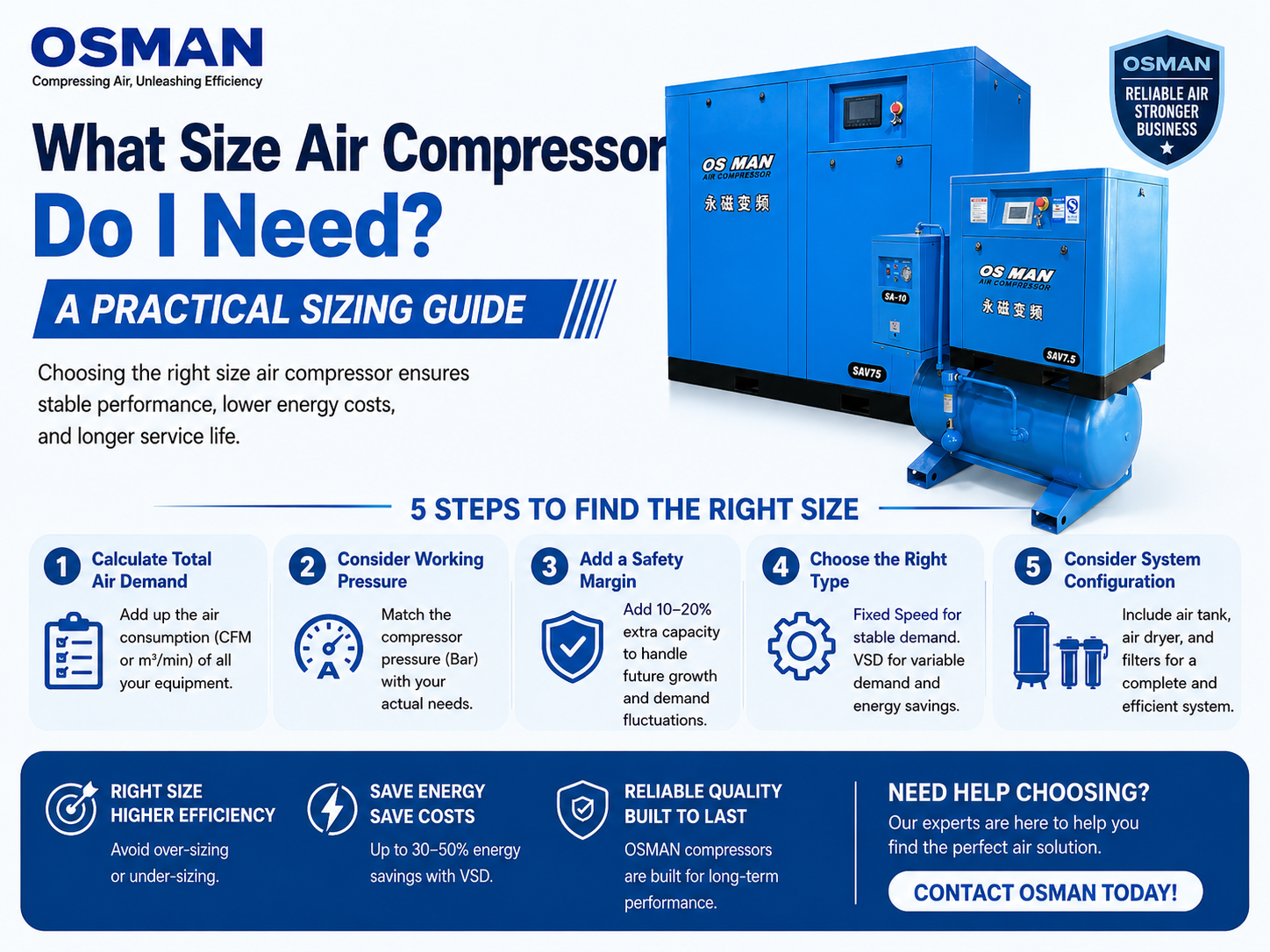
Sizing a screw air compressor correctly isn't just about matching horsepower to your current setup. Pick an undersized unit, and pressure drops will choke your production during peak demand; buy an oversized one, and you’ll burn capital on high upfront costs and excessive energy bills.
To calculate the right compressor size for your facility, you need to look beyond motor power. Key factors like actual air consumption (CFM), working pressure (PSI/Bar), duty cycles, and planned expansion all dictate performance.
In this guide, we’ll walk through the exact step-by-step formula to size your rotary screw compressor and highlight the critical specs to review before placing an order.
1. What Does Air Compressor Size Mean?
When people ask, “What size air compressor do I need?”, they may be referring to several different specifications.
The most common ones are:
- Motor power: KW or HP
- Air delivery: m³/min or CFM
- Working pressure: bar or MPa
- Air receiver capacity: liters
For example, a compressor may be described as a 30HP screw air compressor, but horsepower alone does not tell you how much compressed air the machine can actually deliver.
Two compressors with the same motor power may have different airflow depending on their air end, pressure setting,motor efficiency, and overall design.
2. Calculate Your Required Air Flow
The first step is to determine how much compressed air your equipment consumes.
Check the technical specifications of your pneumatic equipment for air consumption. Depending on the manufacturer, consumption may be listed in:CFM、m³/min、L/min、Nm³/min
Add the air consumption of equipment that may operate at the same time.
For example, suppose a factory has:
- CNC machine: 1.2 m³/min
- Pneumatic tools: 0.8 m³/min
- Spray equipment: 0.7 m³/min
If all three operate simultaneously, the estimated demand is:1.2 + 0.8 + 0.7 = 2.7 m³/min
This does not necessarily mean that a 2.7 m³/min compressor is the best choice. You should also consider peak demand, pressure loss, system leakage, and possible future expansion.
For this reason, when selecting a compressor, always compare Free Air Delivery (FAD) at the required working pressure, rather than looking at HP alone.
3. Determine the Required Pressure
Airflow and pressure should always be considered together.
Common industrial screw compressor pressure ratings include:7 bar、8 bar、10 bar、12 bar、13 bar
Suppose your production equipment requires 7 bar at the point of use. The compressor may need to operate at a slightly higher pressure to compensate for pressure losses through piping, filters, dryers, valves, and other components.
However, increasing compressor pressure unnecessarily can increase energy consumption.
The goal is not to choose the highest pressure available. Instead, determine the minimum practical pressure required by your application and design the system accordingly.
4. Selecting the Right Compressor Capacity
Once you have determined your required airflow and working pressure, use the guide below to match your operational demands with the appropriate compressor motor size:
- 7.5kW (10HP):Ideal for auto repair workshops, woodworking shops, and light pneumatic applications.
- 11kW (15HP):Designed for small automated assembly and light manufacturing lines.
- 22kW (30HP):The sweet spot for medium industrial setups, CNC machine shops, and processing plants.
- 37kW (50HP):Built for medium-to-large manufacturing facilities with steady, multi-shift production.
- 55kW (75HP):Suited for high-demand industrial plants running continuous air supply.
- 90kW–132kW(120–175HP):Heavy-duty solutions engineered for large-scale production, mining, and heavy manufacturing.
Keep in mind that these references are preliminary. Air delivery (FAD) varies based on working pressure. A 30 HP compressor operating at 8 bar will deliver more CFM than the same unit set to 10 bar or 12 bar. Always cross-check the manufacturer’s technical data sheets before making a final selection.
5. Should You Add a Capacity Margin?
In many applications, selecting a compressor with some additional capacity is reasonable.
A small margin can help accommodate:
- Peak air consumption
- Temporary increases in production
- Minor system leakage
- Future equipment additions
However, there is an important difference between a reasonable capacity margin and serious oversizing.
If your actual requirement is 4 m³/min, purchasing a compressor designed for 8 m³/min simply because you want “extra capacity” may result in inefficient operation and unnecessary investment.
For factories expecting significant expansion, it may be better to consider multiple compressors rather than installing one oversized machine.
For example, two appropriately sized compressors can provide greater flexibility than one very large compressor. One unit can operate during low-demand periods, while the second unit starts when production demand increases.
6. Motor Power vs Air Delivery
One of the most common mistakes when buying an air compressor is choosing the machine based only on horsepower.
Motor power indicates the electrical power rating of the motor. It does not directly tell you how much usable compressed air the system will deliver.
When comparing compressors, pay attention to:
- FAD
- Working pressure
- Specific power consumption
- Motor efficiency
- Airend efficiency
- Operating conditions
For example, if two 50HP compressors have different FAD values at the same pressure, the model delivering more air with lower specific power consumption may provide better long-term value.
This is particularly important for industrial buyers because electricity often represents a major portion of the compressor's lifetime operating cost.
An undersized compressor creates severe operational bottlenecks. When output fails to meet air demand, you will experience:
-
Pressure Drops: Starves tools and stalls production lines.
-
Continuous Overload: Forces the unit to run 100% loaded without cooling down.
-
Overheating & Shutdowns: Triggers frequent thermal trips and unexpected downtime.
-
High Maintenance: Accelerates mechanical wear and spikes repair costs.
Bottom Line: Operating a 4 m³/min compressor against a 5 m³/min demand strains your entire air system, burning more energy while risking costly production failures.
Buying an oversized compressor does more than waste capital—it actively destroys your equipment through two critical failure modes:
1. Unloaded Power Waste: Idle machines still pull 25–40% of full power while producing zero compressed air.
2. Oil Emulsification & Rust: Short operating runs prevent the unit from reaching its ideal operating temperature (80°C+). Trapped moisture mixes with oil, ruining lubrication and rusting internal bearings.
3. Severe Component Wear: Constant short-cycling spikes electrical current and accelerates motor switch fatigue.
The Fix: Use a Variable Speed Drive (VSD) compressor. It dynamically matches motor speed to real-time airflow demand, eliminating wasteful short-cycling and protecting internal parts.
-
General Manufacturing: Best suited for Fixed-Speed Screw Compressors when air demand remains constant.
-
CNC Machining: Requires calculating simultaneous operating peak loads to prevent pressure drops across multiple machines.
-
Furniture & Woodworking: Features fluctuating loads (sanding, spraying, tools); ideal for Variable Speed Drive (VSD) compressors.
-
Spray Painting: Requires ultra-stable pressure paired with dedicated air dryers and multi-stage filtration for moisture-free delivery.
-
Large Industrial Plants: Multi-shift facilities benefit from multi-compressor systems or two-stage VSD units for maximum redundancy and energy efficiency.
Sizing an air compressor isn’t about picking the biggest motor you can afford—it’s about matching real-world demand.
Relying on horsepower alone is a trap. Instead, base your calculation on total airflow (CFM), minimum working pressure (PSI/bar), load profiles, air quality specs, and projected expansion. Get it right, and your plant runs smoothly with optimal energy efficiency. Get it wrong, and you’ll either starve your equipment with an undersized unit or burn electricity and ruin oil with an oversized one.
Rule of Thumb: Calculate your actual peak demand, then compare models using their Free Air Delivery (FAD) ratings at your specific target pressure.
Need Help Sizing Your System? Don't guess. Send your supplier your required working pressure, peak CFM, operating schedule, and full equipment list. A proper load profile assessment will lock in the exact capacity you need without wasting capital on unused power.
Q1: Is a bigger compressor always better?
A: No. Oversized units increase initial capital outlay, cause frequent short-cycling, and drastically inflate energy costs.
Q2: How do you convert CFM to m³/min?
A: Use the baseline conversion: 1 m³/min ≈ 35.3 CFM. Always confirm if ratings use FAD (Free Air Delivery) conditions.
Q3: How much extra capacity margin should be added for growth?
A: A standard 15%–25% safety margin covers unexpected peak demand and moderate future shop expansion without oversizing.