

Selecting the right screw air compressor involves more than just finding the largest motor or the lowest price. You must choose a model that matches your real-world airflow needs, working pressure, usage schedule, space constraints, and plans for future expansion.
This guide simplifies the buying process by detailing key factors like airflow, pressure, compressor type, cooling, efficiency, and maintenance.
1. Determine Your Required Air Flow
The first step is to determine how much compressed air your production system actually needs.
Airflow is commonly expressed as:m³/min 、CFM 、L/min
Start by listing all pneumatic equipment connected to the compressed air system and checking the manufacturer's air consumption for each machine.
However, simply adding the consumption of every machine may not give you the actual compressor requirement. Not all equipment operates continuously, and production demand can change throughout the day.
A reasonable capacity margin can help prevent pressure drops during peak demand, but excessive oversizing should be avoided.
2. Select the Correct Working Pressure
After determining airflow, the next step is selecting the required working pressure.
Common industrial screw compressor pressure ratings include:7 bar 、、8 bar 、10 bar 、12 bar 、13 bar 。
The compressor pressure should be based on the actual requirements of the equipment at the point of use.
For example, if your production equipment requires 7 bar, selecting a compressor simply because it can produce 10 or 13 bar does not automatically provide better performance. Higher pressure generally requires more energy.
You should also consider pressure loss between the compressor and the equipment caused by:Piping、 、Filters 、Dryers 、Valves 、Fittings。
The goal is to provide sufficient pressure at the point of use without operating the entire system at unnecessarily high pressure.
3. Choose the Right Compressor Type
Once airflow and pressure requirements are known, you can begin comparing different screw compressor configurations.
The main options include:
(1)Fixed Speed Screw Air Compressor:A fixed speed compressor operates at a relatively constant motor speed and is suitable for applications with stable air demand.
(2)VSD Screw Air Compressor:A Variable Speed Drive compressor adjusts motor speed according to actual air demand. It is particularly useful when compressed air consumption changes throughout the production cycle.
(3)Single Stage Screw Air Compressor:Single stage compression is widely used for general industrial applications and provides a good balance between investment and performance.
(4)Two Stage Screw Air Compressor:Two stage compression divides the compression process into two stages and can provide higher efficiency, particularly for demanding and continuous-duty applications.
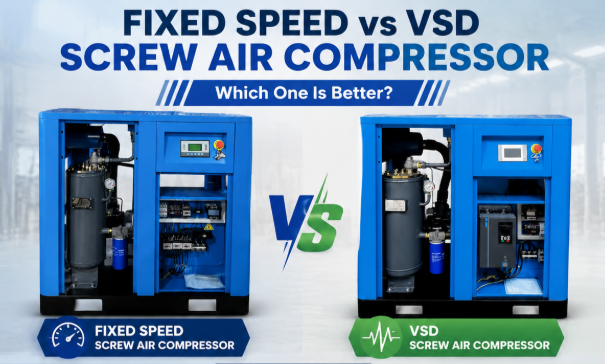
4. Fixed Speed vs VSD Air Compressors
Choosing between fixed speed and Variable Speed Drive (VSD) depends on your plant's air consumption pattern:
- Fixed Speed: Ideal for constant air demand, continuous full-capacity operations, or tight upfront budgets.
- VSD: Best for fluctuating air needs, varying shifts, and cutting long-term electricity costs.
A VSD unit ramps down during slow periods—like night shifts—instead of wasting power at full speed. However, real energy savings depend on your specific demand profile, running hours, and pressure settings.
5. Single-Stage vs. Two-Stage Air Compressor
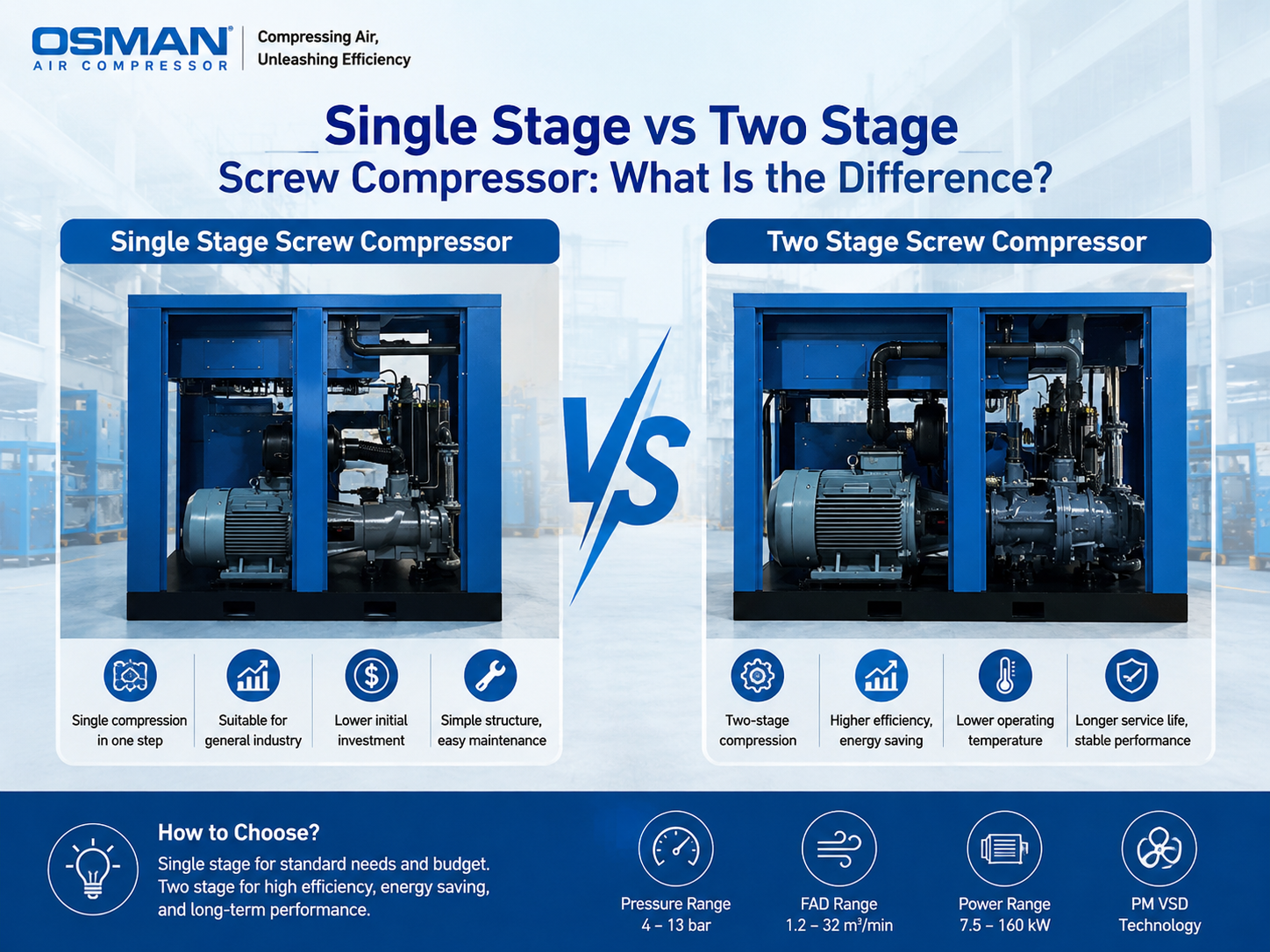
The choice between single-stage and two-stage models comes down to your operating scale and energy goals:
- Single-Stage: Compresses air in one step. Ideal for standard industrial pressure, moderate air demand, shorter operating hours, and lower initial costs.
- Two-Stage: Splits compression into two steps with cooling in between. Best for continuous, high-volume operations where maximum energy efficiency and lower lifetime running costs outweigh higher upfront prices.
6. Air-Cooled vs. Water-Cooled Air Compressor
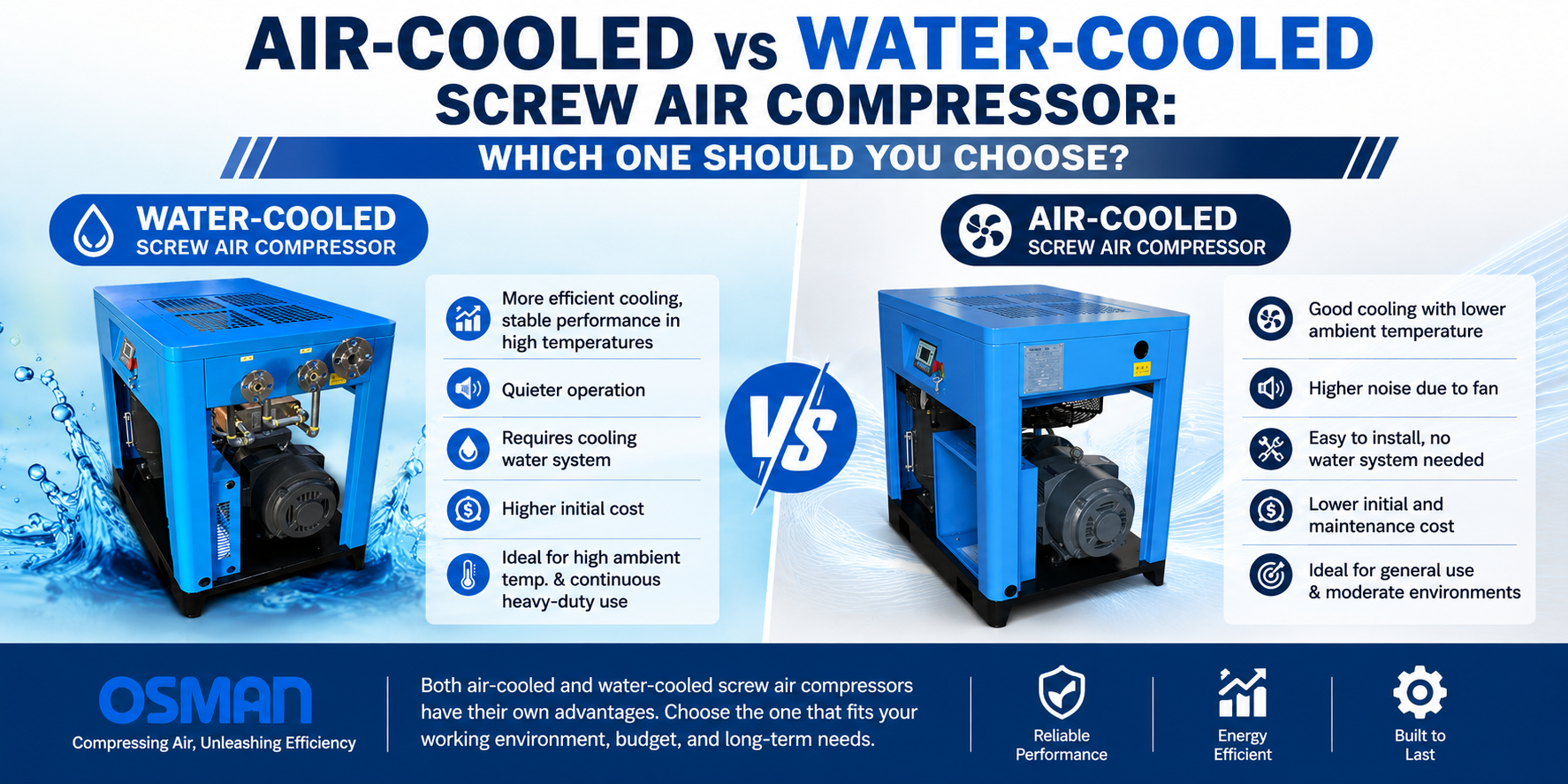
Your choice of cooling depends on factory size, climate, and existing infrastructure:
- Air-Cooled: Uses fans and surrounding air to dissipate heat. Easy to install and budget-friendly, making it ideal for small-to-medium plants, workshops, and general manufacturing with good ventilation.
- Water-Cooled: Uses a liquid cooling loop for heat removal. Built for high-ambient temperatures, continuous heavy-duty use, or large industrial sites with pre-existing water cooling systems. (Requires ongoing water quality and scale maintenance.)
7. Pay Attention to the Operating Environment
Where you place your compressor matters just as much as its specs. Before buying, evaluate these site factors:
- Ambient Heat: High temperatures force the unit to work harder, spiking oil temps and risking shut-offs.
- Dust & Airborne Debris: Dusty facilities clog coolers and filters fast, leading to frequent maintenance.
- Humidity: High moisture increases water condensation, putting extra strain on your air treatment equipment.
- Service Access & Airflow: Avoid squeezing the machine into any tight, leftover corner. Ensure plenty of clearance for ventilation, air filter changes, and routine service access.
8. Match Your Compressed Air Quality Needs
Compressed air isn't one-size-fits-all. Standard oil-injected models paired with basic filters work fine for general pneumatic tools, but sensitive industries like food, pharma, electronics, and medical production demand strict oil- and moisture-free air.
Depending on your process, you may need to add:
-
Refrigerated air dryer or desiccant air dryer
-
Moisture separators and precision filters
-
Activated carbon filters and condensate drains
Always select your compressor as part of a complete treatment system—not just an isolated machine.
9. Match Your Compressed Air Quality Needs
Compressed air isn't one-size-fits-all. Standard oil-injected models paired with basic filters work fine for general pneumatic tools, but sensitive industries like food, pharma, electronics, and medical production demand strict oil- and moisture-free air.
Depending on your process, you may need to add:
- Refrigerated air dryer or desiccant air dryer
- Moisture separators and precision filters
- Activated carbon filters and condensate drains
Always select your compressor as part of a complete treatment system—not just an isolated machine.
10. Factor in Energy Use and Total Operating Cost
The upfront price tag is only a small fraction of what a compressor costs over time. Power bills, oil, replacement filters, routine maintenance, and air treatment gear quickly add up. For machines running long hours, electricity usually becomes the single biggest expense.
When evaluating different models, don't just look at horsepower. Compare key performance metrics like:
- Free Air Delivery (FAD) and working pressure
- Specific power consumption
- Motor and air end efficiency ratings
- Control systems (e.g., fixed-speed vs. smart modulation)
Paying a bit more upfront for an efficient machine often pays for itself many times over through lower monthly power bills.
Final Thoughts
Choosing the right screw compressor requires looking beyond just one spec. Start with airflow and pressure, then factor in your usage patterns, runtime, air quality needs, and environment.
-
Stable use: Fixed-speed is economical.
-
Variable use: VSD saves energy.
-
Heavy-duty: Two-stage lasts longer.
The key is selecting for your actual application, not just horsepower or price. Getting it right ensures reliable production and lower long-term costs.